


9th October 2026
5th May 2025
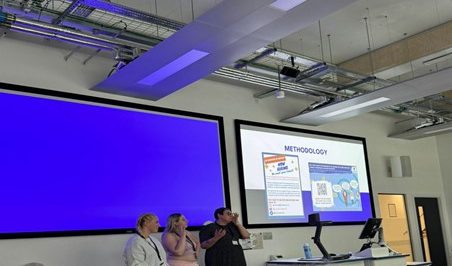
Co-researchers Brittany and Holly share their experiences of attending their first academic conference and the power of lived experience in research.
By Brittany Jackson and Holly Whyte – The University of Sheffield
In the summer of 2024 Danica Darley, a PhD student at the University of Sheffield attended the British Society of Criminology Conference with BrittanyJackson and Holly Whyte who were employed as co-researchers, alongside Alice Downing on her doctoral study. Unfortunately Alice was unable to attend the conference due to unsupported access requirements. Below are Britany and Holly’s reflections on attending their first academic conference.
When we first discussed going to the British Society of Criminology (BSC) conference at the University of Strathclyde in Glasgow in July 2024, we weren’t sure what to expect. As co-researchers with lived experience of the care system and child criminal exploitation (CCE), we worried about feeling out of place. Would we understand the discussions? Would people want to listen to us? Or would it just be a room full of academics talking in a way we couldn’t connect with? The reality turned out to be completely different, and what we took away from the experience was more powerful than we could have imagined.
From the moment we arrived, the atmosphere was welcoming, and people genuinely wanted to listen to us. We had expected the environment to be formal and intimidating, but instead, we found a space where lived experience research was being valued and explored in a meaningful way. The conference wasn’t just about theory; it was about real-world issues, and we quickly realised we had just as much reason to be there as anyone else. Having informal meetups before the main sessions helped ease our nerves. Knowing a few familiar faces before we presented made a massive difference, and by the time we stood up to share our work, we felt like we were part of the conversation rather than outsiders looking in.
“That was when it really hit us – we hadn’t just presented findings; we had communicated something deeper.”
We were excited to present, and having it scheduled toward the end of the week worked in our favour. By then, we had already built connections with people and had spoken about our project informally, which made standing up there a lot easier. The people in the audience were there because they genuinely wanted to listen, and that gave us confidence. The feedback was incredible—people told us how important our voices were and how unique our project was. Some Professors even asked us for advice on how they could incorporate lived experience into their own research, which was something we never expected. It felt like a role reversal—people with big university degrees coming to us for guidance. That was a powerful moment.
After the presentation, there was a plenary session where some of the most well-known criminologists shared how moved they were by our session. One person said they wanted to ask a question but had a lump in their throat and just couldn’t get the words out. That was when it really hit us—we hadn’t just presented findings; we had communicated something deeper. We had embodied the very thing that was missing in a lot of the work being done in this area: real relationships and the power of lived experience.
Throughout the week, we had plenty of opportunities to meet new people, though it was daunting at first. There was a moment where we had to push past our nerves and just go for it. We found that once we started talking, people were genuinely interested in what we had to say. Having support from people like Fern (Gillon) and Beth (Weaver), who introduced us to others, helped massively. If we had walked into the room alone, it would have been much harder to start those conversations. Looking back, it would have been great if there was a more structured way for newcomers to be introduced to others—maybe someone on the organising team acting as a point of contact to help break the ice.
 Speaking up in panel sessions was another nerve-wracking but rewarding experience. At first, we worried about asking questions because we didn’t have the same academic background as many of the attendees. What if we said something that didn’t make sense? But once we built up the courage to speak, we realised people were really responsive and happy to engage with us. They answered in ways that were clear and easy to understand. Some people were asking really technical questions that seemed impossible to answer off the top of your head, but there was space for all kinds of discussions, and that made us feel like we belonged there.
There were a few standout moments during the week. One of the most powerful sessions we attended was about railway safety, where a young woman shared her experience of being electrocuted on train tracks. She was incredibly open talking about how the accident changed her life. It was a real eye-opener—not just about railway safety but about risk in general. Another session that stuck with us was on defunding the police and reinvesting in communities. We hadn’t expected that kind of conversation at a criminology conference, but it was powerful to hear academics arguing for community-based solutions over policing. It made us feel like real change was possible. Another talk that had a big impact on us was about how our justice system can harm children, especially through the language used in policy and practice. This really connected with some of the work we do in schools, and it gave us new ways to explain how words shape experiences.
“Most importantly, remember that you have just as much right to be there as anyone else.”
The conference was well-organised, but there were a few things that could be improved for co-researchers like us. Having more sessions specifically tailored for people with lived experience would be great—not to dumb anything down, but to focus on how we can progress in research, how projects are structured, and how to apply what we learn. It would also help to have better signage and directions because getting lost on the first day was frustrating! We even walked into the wrong building at one point. A short guide on what to expect at a criminology conference would have been useful too, especially for people who are new to these spaces.
For anyone attending an academic conference for the first time, we’d say: plan your sessions in advance and choose the ones that matter most to you, bring a notebook because you’ll want to jot things down, don’t be afraid to ask questions, and take advantage of the social events because they’re a great way to meet people in a more relaxed setting. Most importantly, remember that you have just as much right to be there as anyone else. This conference gave us a huge confidence boost and made us realise that our voices matter in academic spaces. Just because we don’t have formal qualifications doesn’t mean we don’t have valuable knowledge to share. We weren’t just participants in a research project—we were part of something bigger, and that was incredibly validating.

If we could change one thing about our experience, it would be securing full funding so that co-researchers can attend the whole event. Too often, money is a barrier that stops people with lived experience from taking part in academic discussions, and that needs to change. It would also be helpful to have clear communication before the event about who will be attending. There were police officers, lawyers, researchers, and lecturers all in the same space, and that was overwhelming at first. Knowing who would be there and their roles would have helped us feel more prepared.
Looking back, this experience showed us that those of us with lived experience belong in these spaces. People are starting to recognise the value of our insights, and that’s a huge step forward. We hope that future conferences continue to create inclusive environments where people like us can contribute, learn, and be heard. Because at the end of the day, we all have something valuable to bring to the conversation.
If you would like to speak to Brittany, Holly or Alice about their experiences as co-researchers on this project or any other aspect of the study please email d.j.darley@sheffield.ac.uk and she will be happy to put you in touch with them.
Brittany Jackson is a research assistant at the University of Sheffield and a peer support worker for Roundabout, a youth homeless charity in South Yorkshire.
Holly Whyte is a research assistant at the University of Sheffield and a youth worker across Greater Manchester.
Danica Darley is a Research Associate at the University of Sheffield and a lecturer in Applied Custodial Leadership at Leeds Trinity University.